|

|
Biljana
Đordjević Bogdanović, archaeologist
ON ZLAKUSA POTTERY AND ITS
SIGNIFIANCE FOR ETHNOLOGICAL
AND ARCHEOLOGICAL RESEARCH
Famous
from afar for its quality, the pottery from Uzice's region has
become interesting also for scientists as well, from as far
back as the beginning of this century. Long ago, in 1909. Zivko
Joksimovic wrote about it in The Serbian Ethnographic Anthology.
In 1936., Bisenija Perunicic focused her interest right on the
pots from Zlakusa, whilst the most thorough and complete document
on them was made by Natalija Blagojevic in 1973., in The Anthology
of Uzice. The last so far published ethnographic review of the
work of the potters from Zlakusa, Bosiljka Rosic presented in
1983. The same year, Persida Tomic in her monograph "Pottery
in Serbia" united all former knowledge on this subject.
At the beginning of the nineties the archaeologists as well,
got interested in the method of manufacturing Zlakusa's pottery,
which, by all means, represents the most archaic pottery's technique
known in Europe, nowadays. Comparing this pottery and technology
applied in its origination to the knowledge that we have on
prehistoric ceramics, especially ceramics from the iron age,
interesting results can be obtained, also useful for scientific
purposes.
Uniqueness of the pottery, here talked about, is in the material
used for making pots, as 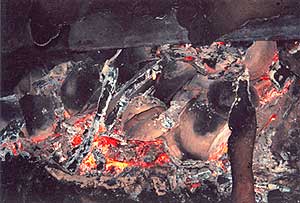 well
as in the very method of manufacture. A perfect combination
of clay (overripen) brought from the village of Vranjani and
calcite (kind of calcite mineral - "vrsta"), dug in
the village of Rupeljevo, in the ideal proportion 1:1, enabled
origination of the pottery which endures for centuries. Even
in the conditions of modern way of living, when the fashion
of metal dishes, it could be said, pushed them back, the pots
from Zlakusa succeeded in surviving and every day they justify
their existance more and more. well
as in the very method of manufacture. A perfect combination
of clay (overripen) brought from the village of Vranjani and
calcite (kind of calcite mineral - "vrsta"), dug in
the village of Rupeljevo, in the ideal proportion 1:1, enabled
origination of the pottery which endures for centuries. Even
in the conditions of modern way of living, when the fashion
of metal dishes, it could be said, pushed them back, the pots
from Zlakusa succeeded in surviving and every day they justify
their existance more and more.
Specificity of these pots make is particularily important for
ethnological and archaeological research. Hand-turned-pottery
wheel, which is nowadays used in Zlakusa, remained in the Balkans
only in some parts of Croatia, Bosnia and Herzegovina. The data
mentioning its existance in Spain and Portugal are old for couple
of decades, so it is possible the rapid modernization in the
last twenty years, has brought to disappearing of this handicraft
in the furthestwest of Europe, too. No matter this assumption
is true or not, Zlakusa, of course, represents if not the last
one, then at least one of the last bastions of hand-turned-wheel
in Europe.
Hand-turned-pottery-wheel is made of wood. In the Balkans there
are four different types, out of which the one from Zlakusa
is most complicated. It consists of round wheel of diameter
33 cm, thickness 5 cm, placed on a shaft of 22 cm height, which
passes through a cross, the parts of which are connected with
the wheel by means of small supports of 14 cm height. The whole
structur is fitted onto a stand thus providing stability.
After preparation, with a piece of clay in the shape of round
bread, a potter starts making dish bottom and building walls.
Adding spirally new pieces of clay in the form of sausage, called
"sudzuk", he continues building a dish, which he will
finish with special tools and turning the wheel one-handedly.
The tools used for that purpose are made of natural materials,
also available to a prehistoric potter. "Bocilo" is
a conical piece of wood, as used from inner side, gives to a
dish a rounded form and at the same time it equalizes wall thickness.
"Kustura" or "kostura" is a wooden knife
which removes clay excess. "Rub" is a piece of cloth
or leather which makes rim and smoothes the dish from outer
side. "Saraljka" is a notched, small wooden stick
(nowadays it is a metal gear) meantfor dish decorating.
Baking
of such made dishes is one specificity more of Zlakusa's potters
work. After couple of days of drying in the air and smoking
in a smoking room, baking in open fire commences. Dishes are
placed on a plat ground, on a base of wooden round logs. All
the structure is surrounded and covered with wooden clogs and
tree branches then set on fire. The baking process lasts until
dishes turn white. The efficency of such a method is quite surprising,
having in mind the minimum temperature necessary for baking
ceramics is 600-700°C and also with regards to the fact the
dishes are exposed to fire unevenly. Finished dishes are of
good quality, fireproof and solid, so they are still in usage,
regardless the dishes made of other materials, commonly used
nowadays.
It is interesting that such a method of pottery-ware manufacture
is preserved right here until present days. According to the
memories of local potters, pottery craft has been developed
in Uzice's region in the last 300 years. In the first half of
XIX century, the greatest number of potters, was exactly her
in the districts of Uzice and Zlatibor. Out of 189 potters in
Serbia, 71 of them were from the region of Uzice, consisting
of the two mentioned districts. In the last two centuries, with
a change of circumstances, demand for pottery-ware decreased,
it was replaced with enameled dishes in households, so the number
of potters was also lessened. The handicraft, however, has not
absolutely faded away until today. It is not by chance that
the last strong base of potters in this region is right here
in Zlakusa.
The potters from Zlakusa are the only ones who endure, because
they used best raw materials and were most skillful ones which
resulted in best quality pots, always very much in demand.
In
the village of Zlakusa at the beginning, 1996.y., 6 potters
have dealed with this craft. Today, 8 years later (2003) there
is more than 40 potters.
|

